
A considered finish for every surface · Explore the Jewell collections ↗

JEWELL PAINTS PRESENTS / A COLOUR READING

One poster.
Two forces.
More than blue
versus red.

The new Ramayana asks us to look at Rama and Ravana. Its poster asks us to look again at the colours between them.

READ THE POSTER
OFFICIAL FILM POSTER © SONY PICTURES / USED FOR EDITORIAL COMMENTARY
01 / THE FIRST LOOK

THE EYE-CATCHING IDEA

Colour tells us where to look.
It doesn’t tell us everything.

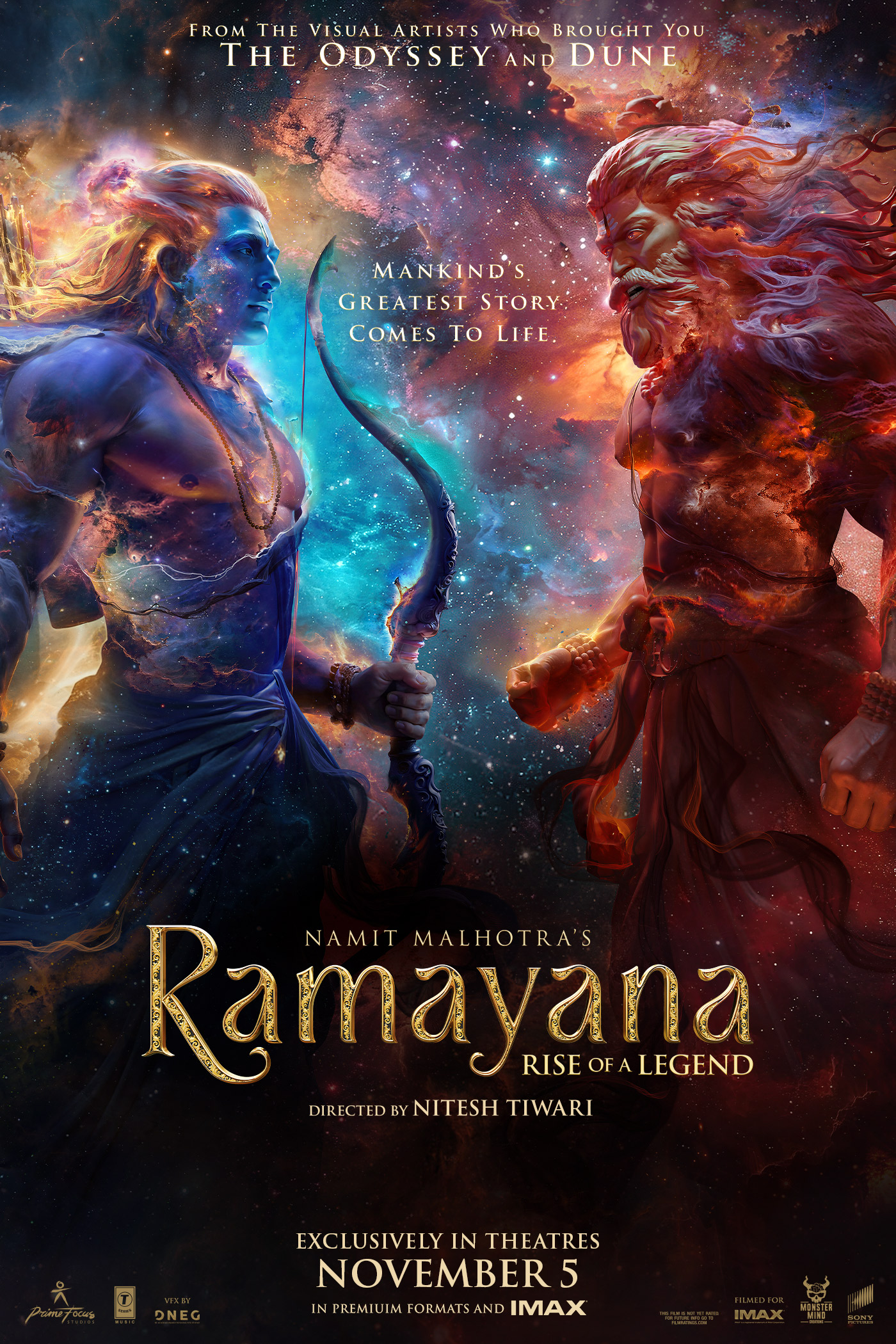
The official poster puts Rama and Ravana face to face across a cosmic field. Cool cyan and blue gather around Rama; ember orange and deep red gather around Ravana. Gold crosses both sides. That is a visual observation. What those colours mean is an interpretation, shaped by the story and by us.

The film opens worldwide on 5 November 2026, according to the official film site. This reading is based on the released poster, not unseen scenes from the film.

02 / THE POSTER DECODED

Tap a colour.
See the story shift.

Four clues in one image. Choose a colour to see what is visible and what we infer from it.

Official Ramayana: Rise of a Legend poster. Rama faces Ravana, with blue and orange light and gold title lettering.THE OFFICIAL POSTER / IMAGE ANALYSIS

COLOUR 01 / RAMA

Blue makes space for stillness.

Look: Cool blue covers Rama’s face and body. Brighter cyan lights the space behind him.

Read: Against Ravana’s surrounding fire, that cool field makes Rama appear composed. The calm is a visual reading, not a claim that blue has one fixed psychological effect.

03 / TWO CHARACTER STUDIES

The same sky.
Different gravity.

01 / RANBIR KAPOOR AS RAMA

Rama

BLUE / CYAN / LUMINOUS GOLD

The cooler colours leave room around his expression. Against the movement of the poster, he reads as a point of stillness. Yet the rim of his hair carries orange light: the image refuses to make his world only blue.

02 / YASH AS RAVANA

Ravana

EMBER / CRIMSON / VIOLET SHADOW

Heat, red light and movement make his presence feel larger and more volatile. But look again: violet-blue streaks run through his hair and the space around him. This is more layered than a flat “red equals evil” shortcut.

04 / THE DETAIL YOU MAY HAVE MISSED

LOOK AGAIN

Their colours cross the line.

Orange lights Rama. Blue-violet touches Ravana. Gold connects the whole composition. The poster still sets up opposition, but the colours make both figures part of the same world. That shared palette is what gives the face-off its scale.

05 / BEYOND THE FACE-OFF

A larger story.
Many ways to see it.

Rama and Ravana dominate the poster. The epic opens out through other people whose choices move the story forward. These palettes are our editorial reading, not colours assigned to them by scripture or the upcoming film.

Sita — character reference supplied for this colour story

THE ASHOKA GROVE

Sita

In the story: Sita is held in Lanka’s Ashoka grove. Hanuman finds her there amid trees and flowers.

Our colour parallel: Leaf green and soft gold set life and light against the confinement of the scene. They suggest endurance here; they are not a canonical Sita palette.

Lakshmana — character reference supplied for this colour story

THE FOREST EXILE

Lakshmana

In the story: Rama’s brother Lakshmana accompanies Rama and Sita into exile; the Dandaka forest becomes part of their journey.

Our colour parallel: Bark brown and deep green keep attention on the landscape they share, while blue-grey echoes the poster’s quieter side. This is an interpretation, not a costume reference.

Hanuman — character reference supplied for this colour story

THE JOURNEY TO LANKA

Hanuman

In the story: Hanuman crosses the sea in search of Sita, finds her in Lanka and brings news back to Rama.

Our colour parallel: Ocean blue gives the journey scale; warm coral and gold mark the moment of discovery. The colours illustrate movement through the story, not a fixed meaning for Hanuman.

06 / PLACES THAT CARRY THE EPIC

The world changes.
So does the palette.

The Ramayana’s settings carry details of their own. We draw colour from descriptions in the epic, then use it to think about how a scene can feel.

01

MOUNTAIN · RIVER · FOREST

Chitrakuta

In one passage, Chitrakuta’s forest appears from afar like a blue cloud beside the Mandakini river. Its colour belongs to the text itself; our deep blue and river green are a visual response to that description.

AYODHYA KANDA, 2.93.8
02

FLOWERS · WATER · SHADE

The Ashoka grove

The grove Hanuman enters is full of flowering trees, birds and water. Its abundance sits beside Sita’s captivity: the contrast makes the place more complex than a simple sanctuary.

SUNDARA KANDA, CHAPTER 14
03

ISLAND · GARDEN · GOLD

Lanka

In the passage describing Hanuman’s search, Lanka includes gardens, golden details and pale structures. It is a reminder that the epic’s opposing world has richness and texture beyond the poster’s fiery red.

SITA DISCOVERED, BOOK VIII

Editorial colour parallels, not reconstructions of historical locations, scripture-approved symbolism or scenes confirmed for the forthcoming film.

THE EDITORIAL NOTES

What we know.
What we read into it.

On screen

The image here is the official promotional poster published on the Sony Pictures film site. Our descriptions of blue, warm light, red, violet and gold are observations of that image. The creative interpretation is Jewell’s own.

About the film

The official synopsis describes Rama as a prince bound by sacrifice and Ravana as a king driven by vengeance. Prime Focus Studios identifies Nitesh Tiwari as director. We have not seen the unreleased film.

About the shades

The character and place cards use passages from the Ramayana and an educational overview linked on each card. Their palettes are our creative interpretation, not a claim about traditional iconography or the forthcoming film. The poster and film belong to their respective rights holders. This independent colour story is not affiliated with or endorsed by the filmmakers or Sony Pictures.